
Impact report
2020–2025
30 June 2026
About Index
Index is an independent, non-profit investigative NGO founded in France in 2020. It brings together journalists, researchers, filmmakers, architects, and other experts around a single mission: using digital technologies to establish the truth and demand justice in cases of public interest.
Index mainly investigates alleged acts of violence and violations of fundamental freedoms or human rights, with particular attention to police violence. Its landmark investigations include those into the deaths of Adama Traoré, Nahel Merzouk, and Zineb Redouane, as well as into the “Napalm Girl” photograph.
At once an independent expert analysis practice, an investigative media outlet, and a research laboratory in digital investigation, Index works wherever its expertise can have a concrete impact. Its investigations are published in partnership with respected international media, and its expert reports are regularly added to the case files in the relevant proceedings.
Born of the pioneering work of the London-based agency Forensic Architecture and a member of the international Investigative Commons network, Index also works to spread the methods of digital investigation within civil society, through training workshops and public talks.
Index is the only organisation in France to offer independent expert analysis in digital investigation to all victims of abuses of power, in the public interest.
In the words of those directly affected
To mark its fifth anniversary, Index gathered testimonies from victims of police violence and their relatives, whose fight for truth and justice its independent investigations have supported.
-
 Assa Traoré: “Index’s investigations must continue”
9 Oct 2025
Assa Traoré: “Index’s investigations must continue”
9 Oct 2025
-
 Issam El Khalfaoui: “Index does the work that the justice system fails to do”
20 Oct 2025
Issam El Khalfaoui: “Index does the work that the justice system fails to do”
20 Oct 2025
-
 Jérôme Rodrigues: “You are doing rare and concrete work”
23 Oct 2025
Jérôme Rodrigues: “You are doing rare and concrete work”
23 Oct 2025
-
 Fatiha M.: “Index is of vital public interest”
13 Oct 2025
Fatiha M.: “Index is of vital public interest”
13 Oct 2025
-
 Jean-François Martin: “I never imagined I would receive such support”
6 Oct 2025
Jean-François Martin: “I never imagined I would receive such support”
6 Oct 2025
-
 Mahamadou Camara: “Index’s work helped set the record straight”
2 Oct 2025
Mahamadou Camara: “Index’s work helped set the record straight”
2 Oct 2025
-
 Christelle Vendeiro-Bico: “For bereaved families, Index is essential”
15 Oct 2025
Christelle Vendeiro-Bico: “For bereaved families, Index is essential”
15 Oct 2025
-
 Dominique Rodtchenki-Pontonnier: “We were able to walk into court with our heads held high”
8 Oct 2025
Dominique Rodtchenki-Pontonnier: “We were able to walk into court with our heads held high”
8 Oct 2025
-
 Nordine A.: “We need your support”
12 Mar 2026
Nordine A.: “We need your support”
12 Mar 2026
Editorial: Five years of impact on every front


Between its launch in 2020 and the end of 2025, Index published 23 investigations, and its reports were added to the case files of 20 legal proceedings. Behind these figures lies concrete impact: our work has reopened closed investigations, prompted investigating judges to order new expert reports, freed people who had been wrongly accused, and helped ensure that officers implicated in violence were placed under formal investigation (mise en examen), ordered to stand trial, or convicted.
At the same time, our reconstruction videos have circulated in every public arena where truth and justice are negotiated. They have been published in the pages of Le Monde, Libération, Disclose, Rolling Stone, and Il Manifesto, and widely shared by other independent media and on social media. They have been screened in courtrooms and added to the case files of proceedings in which victims’ accounts are routinely doubted. Presented by our team, they have provided the basis for discussion in classrooms, lecture halls, and the meeting rooms of grassroots collectives. One of them is at the heart of a documentary released on Netflix, which led World Press Photo to suspend the attribution of “Napalm Girl” – one of the most famous images in the history of photography.
At a time when the mass circulation of images and information is blurring our ability to tell true from false, the risk is one of widespread resignation to the idea that the facts can no longer be settled.
These results stem from what makes Index unique: we are not only a media outlet, nor only an expert analysis practice, nor only a research laboratory in digital investigation. We are all three at once – and it is this hybrid nature that multiplies our impact. When we publish an investigation in the press, it is simultaneously filed with the court. When we reconstruct a contested incident in 3D, the model serves journalists, lawyers, and public debate alike. When we train students or activists, we pass on tools forged in the urgency of real cases.
The context demands it: at a time when the mass circulation of images and information is blurring our ability to tell true from false, and when trust in the traditional arbiters of truth is crumbling, the risk is one of widespread resignation to the idea that the facts can no longer be settled. Resisting it means acting on every front, in every arena, to produce rigorous analyses and verifiable conclusions, without compromise. This is what Index has been doing from the start.
Behind this record, Index remains a small organisation with limited means. The cases we take on are the result of sometimes difficult choices among the many requests we receive, in favour of those where our digital investigation methods can make a difference. The words of the families we support, which open this report, say it better than any set of figures: our most important impact lies in our work’s ability to advance – sometimes decisively – individual struggles for truth and justice.
What we have achieved in five years, we have done thanks to the support of more than 1,200 donors, committed foundations, and partners who believe in our mission. The pages that follow are an account of this collective effort. Faced with the challenges ahead – an ever-thicker fog of information compounded by a global slide towards authoritarianism – the work of independent investigative organisations such as Index becomes more necessary and more urgent every day. These pages also give a sense of what we could achieve with greater resources.
A vertical approach to impact
Media outlets and NGOs generally measure their impact in terms of the volume of media coverage, institutional uptake, and resonance in the public sphere – an approach that could be described as horizontal. Index favours a vertical approach to impact: we concentrate our resources, over the long term, on a limited number of cases, chosen for the potential our expertise has to transform the outcome of a case, public understanding of the facts, and the ability of those affected to assert their rights.
The case as a prism
Our method, inherited from Forensic Architecture and forged through experience, rests on one principle: a single case, painstakingly reconstructed in all its complexity, makes tangible a structural problem that statistics or a bird’s-eye view leave abstract.
The deaths of people in exile who drown trying to cross the Channel are regularly reported in brief news items, without holding public attention for long. When Index reconstructed in 3D the night Jumaa al-Hasan, a 27-year-old Syrian in exile, died – gathering the testimonies of those who were there and pinpointing exactly what the officers deployed that night were responsible for – the structural problem of border violence became concrete, visible, and unacceptable. AFP picked up the investigation, a complaint was filed, and prosecutors opened a judicial inquiry and referred it to the IGPN, the police’s internal affairs body.
Every Index investigation works in this way: the individual case, because it captures the texture of reality, becomes a prism through which a broader dynamic can be seen, understood, and grasped far more clearly than from a statistical or top-down angle. The death of Nahel Merzouk is the prism through which to see the issue of drivers refusing to stop for the police (refus d’obtempérer) and the lethal use of firearms by officers. The “Napalm Girl” photograph is the prism of the Western media system’s confiscation of Vietnam’s history from the Vietnamese. The Saint-Louis deaths in Kanaky-New Caledonia are the prism of the routine resort to exceptional measures in France’s overseas territories.
Concentrating on the critical point
With a small team and a modest budget, Index cannot cast a wide net. Nor is that our ambition. We concentrate our resources on a critical point: the exact place where our expertise in digital investigation can tip the balance in how the facts are understood.
This focus is a strategy, not a constraint imposed on us. If we manage to change the course of a case – how it is understood by the public, how it ends in court – that result becomes a concrete source of hope for every comparable situation. On 7 November 2024, when the Bobigny court convicted two officers of the Stains BAC, a plainclothes anti-crime unit, of firearms violence against a driver who had refused to stop, a dam broke. It showed that independent counter-expertise can stand up to the institutional mechanisms that tend to guarantee police impunity. A single ruling changes what is possible for every family engaged in a similar struggle.
This is what makes our impact transformative: each concrete result – a conviction, an officer placed under investigation, the collapse of an official account, the release of someone wrongly accused – acts as a catalyst for deep change, far beyond the individual case.
Local roots, global perspective
Index’s strategy is to establish the methods of digital investigation in France on a lasting footing, and to deploy them within an existing network of committed actors – victims’ family committees, grassroots collectives, lawyers, media outlets, NGOs – with whom we build long-term relationships.
These local roots do not preclude an international reach – they feed it. Each of our French cases resonates with similar situations around the world: police violence, abuses of state power, the erasure of victims. Born of Forensic Architecture and a member of the Investigative Commons network, Index is part of a solidarity that crosses borders, and takes its methods into other contexts when the opportunity arises: in Kanaky-New Caledonia, Italy, occupied Palestine, the United States… The investigation into the “Napalm Girl” photograph, at the heart of a documentary released worldwide on Netflix, has greatly accelerated this international recognition.
Our impact in figures
How Index measures its impact
In addition to the vertical, qualitative approach to impact described above, we systematically document the concrete effects of our investigations in a database. Each entry is a verifiable trace of our work’s effects in the real world: a report added to a case file, an article in the press, a presentation at a conference, a citation in an official report. The most significant are flagged with the Major label.
We classify these effects into four categories: judicial (reports added to case files, expert reports ordered, court decisions…), media (press coverage, social media sharing…), public (interviews, talks, training…), and institutional (citations in official reports or decisions…). We also count the testimonies we receive from those who have benefited from Index’s work.
How we count judicial impact: we only count as an effect of Index’s work those developments in a case that would not have happened without our intervention. The test is not whether we are cited in a police report or a court ruling, but whether a causal link can be traced between our work and the decision in question. Where this link cannot be established, we record the development in the story of the investigation, or cover it in an article in the Dispatches section, without counting it towards Index’s impact.
Some of our work concerns proceedings still covered by judicial secrecy (secret de l’instruction), whose details cannot be disclosed. These impacts are included in our totals and appear in the public database in redacted form, identified by the Sealed label.
This quantitative tracking is a tool for transparency and accountability. It does not claim to capture our impact on its own: its transformative nature is best measured in the story of each investigation told in this report.
This approach is inspired by the pioneering work of our partners at Disclose, whose annual impact report and impact journalism guide (produced with Rembobine) were our main methodological references.
Other indicators:
- 1,200 Donors individual
- 36,000 Subscribers across all our platforms
- 5,000,000 Views of our video investigations
- 150 Participants in Index’s training workshops
The impact of our investigations
A selection of seven investigations with major impact, traced here from the initial counter-investigation through to its concrete effects.
 Case: Zineb Redouane ↗
The death of Zineb Redouane
On 1 December 2018, on the sidelines of a Yellow Vests protest in Marseille, Zineb Redouane, aged 80, was fatally wounded in the face by a tear gas grenade fired from a Cougar launcher while she stood at the window of her flat. The judicial investigation, entrusted to the IGPN, was quickly marred by serious failings: misplaced evidence, no identification of the shooter, and a refusal to investigate the circumstances of the shot.
Carried out within Forensic Architecture and published with Disclose, Index’s investigation drew on all available images – amateur videos, press photographs, CCTV footage – to reconstruct precisely the trajectory and timing of the shot. Where the official expert report had cleared the shooter, Index’s analysis established the opposite: the way the shot was fired was both against the rules and dangerous.
The findings had an immediate effect on the proceedings. In the summer of 2021, the IGPN cited Index’s investigation in its report formally identifying the shooter – a CRS riot police officer – and recommending that a disciplinary board be convened. The officer was placed under formal investigation for involuntary manslaughter on 28 November 2024, six years after the events: a result directly linked to the sustained pressure of a public counter-expertise.
Together with the investigation into the death of Adama Traoré carried out the same year, the reconstruction of the shot that killed Zineb Redouane is one of the two founding investigations that led to Index being set up as an independent organisation based in France. It shows that independent digital investigation can reopen stalled cases and push the courts to act where they had previously shied away from doing so.
Impact at a glance
Media – Publication with Disclose, picked up in an AFP dispatch, very wide national coverage.
Judicial – Index’s counter-investigation cited in the IGPN report recommending disciplinary sanctions against the shooter (2021). Officer placed under formal investigation for involuntary manslaughter (November 2024).
Significance – First demonstration that Index’s counter-expertise can unblock proceedings stalled by the failings of the official investigation.
 Case: Adnane Nassih ↗
How Adnane Nassih lost an eye
On 22 February 2020, in Brunoy, Adnane Nassih, aged 19, lost an eye to a rubber projectile fired from an LBD 40 launcher during a police operation in the Hautes-Mardelles neighbourhood. The judicial investigation initially rested on the account of the officer involved, who said he had fired in response to an attack. The available footage, barely analysed, told an entirely different story.
Index’s investigation, published in partnership with Libération in May 2021, examined all of the video sequences documenting the minutes leading up to the shot. The reconstruction established that at the moment the officer fired, Adnane Nassih was moving away from him with his back turned. Nothing justified the use of the weapon. The rules governing use of the LBD – which require proportionality and immediate necessity – were not followed.
Published on the front page of a national daily, the investigation achieved unprecedented visibility for a case of maiming by the police. It was a mark of editorial recognition for Index, and opened the door to further collaborations with leading newspapers.
In January 2025, the officer was ordered to stand trial before the criminal court (cour criminelle) for “assault by a person vested with public authority resulting in permanent disability” – a crime carrying up to fifteen years in prison. It is rare for an LBD shot to reach a criminal court, and this shows that video counter-expertise can shape how the facts are classified in law – not just whether they are recognised as having happened.
The case of Adnane Nassih is part of a series of Index investigations into crowd-control weapons (Rodrigues, Lognonne, Pontonnier), forming a coherent body of work on a French approach to the use of force that is an exception in Europe.
Impact at a glance
- Media – Front page of Libération: a first for Index. Case featured in a podcast episode of “Affaires sensibles” (France Inter, 55 min, January 2022).
- Judicial – Officer ordered to stand trial before the criminal court (January 2025) for a crime carrying up to 15 years in prison.
- Significance – Shows that an unjustified LBD shot can lead to a criminal trial for the shooter.
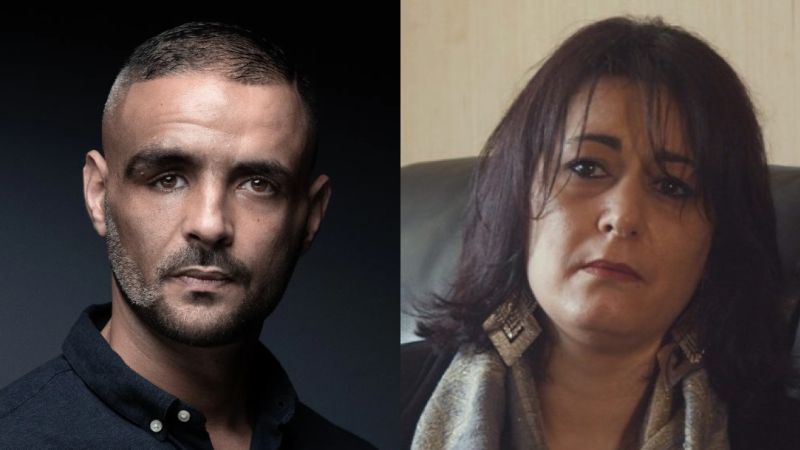 Case: Nordine A. & Merryl B. ↗
The BAC shooting in Stains
On the night of 15 to 16 August 2021, in Stains, officers of the BAC anti-crime unit opened fire eight times in six seconds on the car in which Nordine A. and Merryl B. were travelling. He was seriously injured; she was hit in the back and lost the child she was carrying. The officers claimed self-defence, saying the driver had refused to stop.
Index’s investigation, published in October 2022 with StreetPress and Le Bondy Blog, reconstructed the scene in three dimensions from smartphone footage captured by a witness. The model pinpointed the position of each officer relative to the car’s path at the moment the shots were fired. The result was unambiguous: no officer was in the path of the car. The legal conditions for self-defence – imminent danger and proportionality – were not met.
Added to the case file, the 3D reconstruction helped ensure that the officers who fired stood trial before the Bobigny criminal court (tribunal correctionnel). At the trial, Index’s video was screened in court and formed the basis for argument between the parties. It allowed the court to see, frame by frame, that the police account was physically impossible. On 7 November 2024, the two officers were given four-year suspended prison sentences and permanently banned from serving in the National Police.
This ruling is exceptional. In France, convictions of police officers for shooting at drivers who refused to stop can be counted on the fingers of one hand. The Stains judgment cracks the dam: it establishes that an independent digital reconstruction can, on its own, influence the criminal outcome of a police shooting case. For families in comparable proceedings, it is a decisive precedent.
Impact at a glance
- Media – Investigation published with a network of independent media: StreetPress, Le Bondy Blog, Politis…
- Judicial – Investigation screened in court and used as the basis for argument between the parties. Both officers given 4-year suspended prison sentences and permanently banned from the police (November 2024).
- Significance – A rare conviction in France of officers who fired at a driver refusing to stop. A significant legal precedent.

The killing of Nahel Merzouk
On the morning of 27 June 2023, in Nanterre, Nahel Merzouk, aged 17, was shot in the chest and killed by a police officer during a traffic stop, after refusing to pull over. Filmed and shared on social media, the scene set the country ablaze and triggered several nights of rioting. But the footage, which showed only part of what happened, left room for debate: the officer who fired claimed he had acted in self-defence, fearing he was about to be run over.
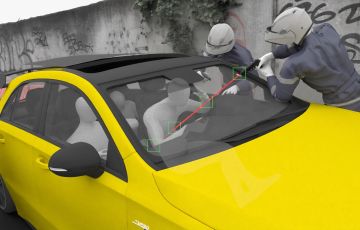
Index stepped in within days with an initial audio analysis of the words audible in the video (with the NGO Earshot). It was quickly picked up – and misrepresented – on France 2’s 8 pm news. Then, on 27 June 2024, for the first anniversary of Nahel’s death, Index and Blast published a full 3D reconstruction of the events.
By cross-referencing all available sources – including previously unseen CCTV footage – this reconstruction revealed to the public what the social media video alone did not show: as it set off, Nahel’s car moved away from the kerb, contradicting the police account that the officer was at risk of being crushed against the low wall behind him. It also reconstructed exactly where Nahel Merzouk was sitting when the shot fired through the windscreen hit him in the chest. The 16-minute video was added to the case file by the lawyers for Nahel’s family.
On 3 June 2025, the investigating judges ruled out self-defence and ordered the officer to stand trial for murder before the Hauts-de-Seine assize court (cour d’assises) – an exceptional decision in the history of police violence in France. The accused has appealed; the trial, initially scheduled for 2026, could take place in 2027.
Impact at a glance
- Media – Full 3D reconstruction / video published with Blast (June 2024), based on previously unseen CCTV footage.
- Judicial – Video added to the case file. Officer ordered to stand trial for murder before the assize court, self-defence ruled out (June 2025) – an unprecedented decision. Trial expected in 2027.
- Significance – A counter-investigation that publicly established, with supporting evidence, what the viral video did not show and the police account concealed, in a case of police violence that resonated nationally and internationally.

The drowning of Jumaa al-Hasan
On the night of 2 to 3 March 2024, on the beach at Gravelines, Jumaa al-Hasan, a 27-year-old Syrian in exile, drowned while trying to reach a boat to cross the Channel. Such drownings, an almost daily occurrence on the Franco-British border, rarely get more than a brief mention in the news.
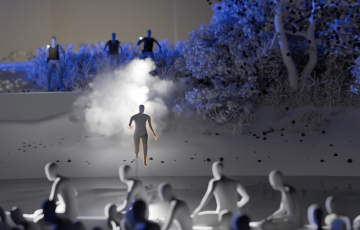
Index’s investigation, in collaboration with Liminal and Hors-Cadre, published in July 2025 with Disclose and The New Arab, broke this pattern. By gathering the testimonies of those present that night and cross-referencing the available footage, it reconstructed the sequence of events in 3D. The police operation and the officers’ actions were reconstructed minute by minute. The reconstruction showed the direct responsibility of the police in the chain of events that led to Jumaa al-Hasan’s drowning – and the subsequent failure to assist a person in danger.
The publication was picked up by AFP and received wide coverage in France and abroad. In its wake, the NGO Utopia 56 filed a complaint for involuntary manslaughter. Dunkirk prosecutors opened a judicial inquiry and referred it to the IGPN. Within days, a death at the border had become a live court case, with official investigations under way.
Beyond the individual case, this investigation marks a strategic broadening of Index’s work to border violence. The structural problem of French and European migration policy, usually discussed through statistics or opinion pieces, becomes concrete, visible, and open to legal challenge.
Impact at a glance
- Media – Multilingual publication in partnership with Disclose (in French) and The New Arab (in English / Arabic). Picked up in an AFP dispatch. Wide national and international coverage.
- Judicial – Complaint filed by Utopia 56 for involuntary manslaughter. Judicial inquiry opened by Dunkirk prosecutors, case referred to the IGPN.
- Significance – Index’s first case of border violence. A strategic extension of its field of work.
The three deaths in Saint-Louis (Kanaky)
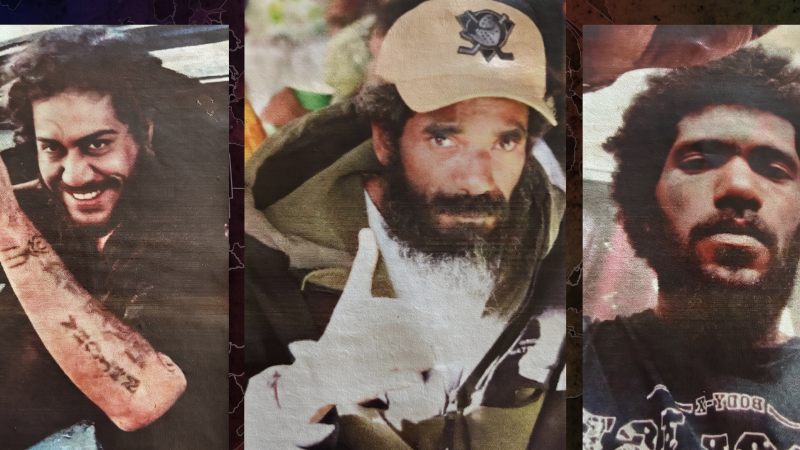
In the spring of 2024, Kanaky-New Caledonia rose up against a proposed reform of the electoral roll. East of Nouméa, the Kanak community of Saint-Louis, a pro-independence stronghold, became the last active centre of the uprising. Between July and September 2024, three Kanak men – known as Banane, Samy, and Johan – were shot dead there by the GIGN, the elite unit of the National Gendarmerie.
In November 2024, Index’s team went into the field. It gathered dozens of testimonies from relatives, residents of Saint-Louis, and those involved in the negotiations, collected previously unseen documents and images, and produced precise surveys and 3D scans of the sites. The investigation was then developed over several months in partnership with Le Monde, and published on 16, 17, and 18 July 2025 as a series of three interactive articles under the title “Les martyrs de Saint-Louis” [The martyrs of Saint-Louis].
Beyond the circumstances of the shootings themselves, in which the conditions for self-defence do not appear to have been met, the investigation and its ramifications showed how the French state, through its gendarmes, used every means available to restore order in Saint-Louis. The series gave the three deaths unprecedented visibility, rescuing them from being treated as peripheral crime news.
For Index, this was its first work on Kanak soil. At the scale of a whole territory, it extends the principle underpinning Index’s work: a single case, painstakingly reconstructed, makes tangible a structural problem that statistics or a bird’s-eye view leave abstract – here, the way the French state administers force in its overseas territories, in a manner that in many respects still bears the marks of a colonial relationship.
Impact at a glance
- Media – Three-part series in Le Monde (16, 17, and 18 July 2025) under the title “Les martyrs de Saint-Louis”.
- Judicial – Judicial investigations under way into the three deaths.
- Significance – Index’s first work in Kanaky-New Caledonia. A prism for the use of exceptional measures in the overseas territories.
The attribution of the “Napalm Girl” photograph
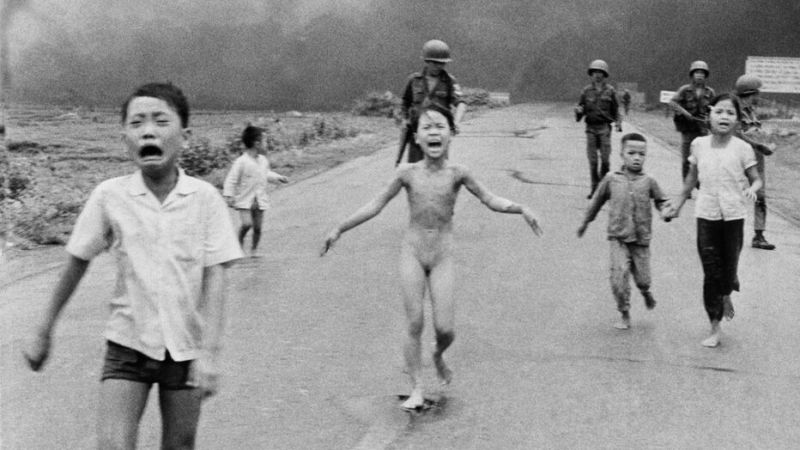
In 2024, the VII Foundation approached Index for an independent expert analysis of one of the most famous photographs in history: “Napalm Girl”, taken on 8 June 1972 during a napalm attack on the village of Trảng Bàng, and officially attributed to the photographer Nick Ut. The VII Foundation had gathered evidence challenging this attribution in favour of Nguyễn Thành Nghệ, an independent Vietnamese photographer present that day. It asked Index to weigh this evidence through an expert analysis of the images taken at the scene.
Index drew on all the visual material from the scene – photographs by several journalists present, television news footage, maps and plans – to reconstruct in three dimensions the exact layout of the site and the movements of the photographers at the moment the picture was taken. From the relative positions established, the model showed that it is highly unlikely that Nick Ut took the photograph.
Beyond the question of attribution, the case is a prism for a broader dynamic: the systematic appropriation of the work of local journalists in war zones – Vietnamese, Cambodian, Afghan, Palestinian – by foreign correspondents.
The investigation is at the heart of the documentary The Stringer, which premiered at Sundance in January 2025 and has been streaming on Netflix since November 2025. It sparked a global debate with Index’s reconstruction at its centre – the Washington Post, The Guardian, CNN, NPR, Time, The Wall Street Journal, Vanity Fair, the Los Angeles Times, and Variety all covered it extensively. On 26 June 2025, World Press Photo suspended the attribution of the photograph to Nick Ut – an unprecedented decision for such an iconic image.
This investigation marks a turning point in Index’s international recognition. It shows that its digital investigation skills can be applied to global historical questions, and establishes Index as a leading player well beyond France.
Impact at a glance
- Media – Documentary The Stringer screened at Sundance and released on Netflix, nominated for 4 Emmy Awards. Worldwide coverage (Washington Post, The Guardian, CNN, NPR, Time, WSJ, etc.).
- Institutional – Suspension by World Press Photo of the photograph’s attribution to Nick Ut (June 2025).
- Significance – A turning point in Index’s international recognition. The method extended to global historical questions.
All our investigations
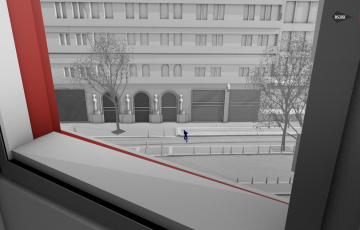
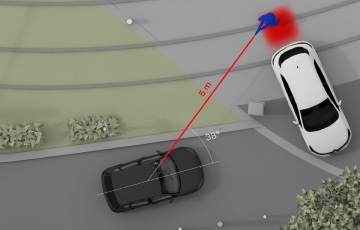
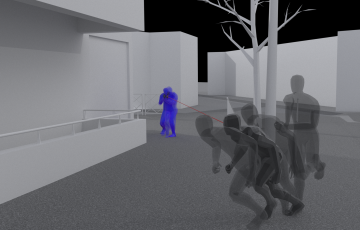
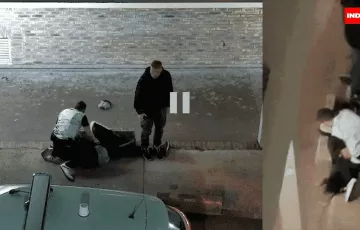
-
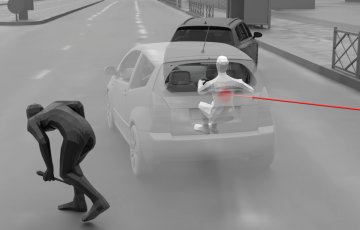
 How Jérôme Rodrigues lost an eye: what police body cameras reveal
8 Jun 2023
How Jérôme Rodrigues lost an eye: what police body cameras reveal
8 Jun 2023
-
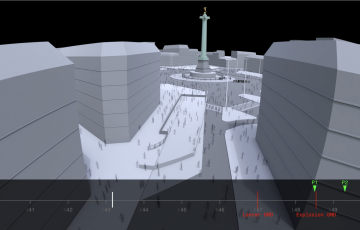 The Jérôme Rodrigues case: no projectile before the grenade was thrown
15 Jun 2023
The Jérôme Rodrigues case: no projectile before the grenade was thrown
15 Jun 2023
-
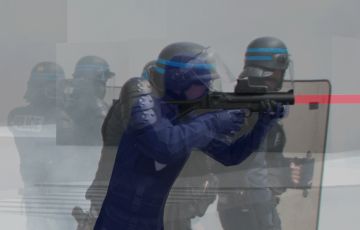 LBD shooting of Jean-François Martin: the police officer identified through 3D modelling
26 Jun 2023
LBD shooting of Jean-François Martin: the police officer identified through 3D modelling
26 Jun 2023
-
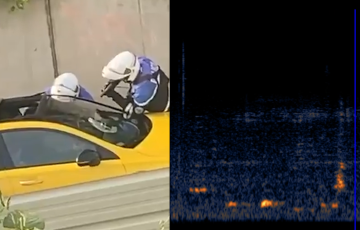 Killing of Nahel in Nanterre: initial findings of the audio analysis
3 Jul 2023
Killing of Nahel in Nanterre: initial findings of the audio analysis
3 Jul 2023
-
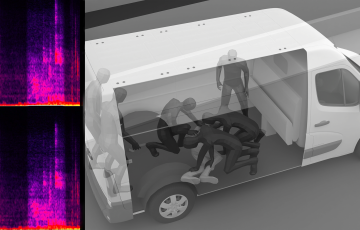 The L’Île-Saint-Denis case: analysis of the full audio recording
13 Sep 2023
The L’Île-Saint-Denis case: analysis of the full audio recording
13 Sep 2023
-
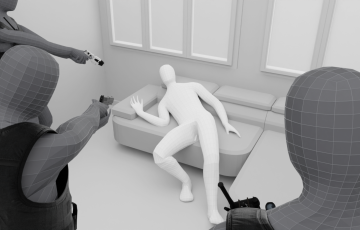 Killing of Bilal M.: 3D reconstruction invalidates the police account
1 Feb 2024
Killing of Bilal M.: 3D reconstruction invalidates the police account
1 Feb 2024
-
 Deaths of Adam and Raihane: inconsistencies in the police account exposed
11 Mar 2024
Deaths of Adam and Raihane: inconsistencies in the police account exposed
11 Mar 2024
-
 The killing of Nahel Merzouk
27 Jun 2024
The killing of Nahel Merzouk
27 Jun 2024
-
 A legal insecurity: Article L. 435-1 and the death of Luis Bico
1 Nov 2024
A legal insecurity: Article L. 435-1 and the death of Luis Bico
1 Nov 2024
-
 Arrest of Tiziano L. in Rome: the counter-investigation refutes the police account
12 Nov 2024
Arrest of Tiziano L. in Rome: the counter-investigation refutes the police account
12 Nov 2024
-
 When the experts go astray: a denial of justice for Michael Lognonne
28 Mar 2025
When the experts go astray: a denial of justice for Michael Lognonne
28 Mar 2025
-
 Drowning of Jumaa al-Hasan: the police implicated
8 Jul 2025
Drowning of Jumaa al-Hasan: the police implicated
8 Jul 2025
-
 Three killings in Saint-Louis, Kanaky-New Caledonia
16 Jul 2025
Three killings in Saint-Louis, Kanaky-New Caledonia
16 Jul 2025
-
 Gabriel Pontonnier, maimed by a police grenade
9 Sep 2025
Gabriel Pontonnier, maimed by a police grenade
9 Sep 2025
-
 Who took the “Napalm Girl” photograph? Analysis and 3D reconstruction
28 Nov 2025
Who took the “Napalm Girl” photograph? Analysis and 3D reconstruction
28 Nov 2025
-
 The execution of Khaled and Nidal ‘Amirah in Nablus
9 Dec 2025
The execution of Khaled and Nidal ‘Amirah in Nablus
9 Dec 2025
Index’s investigations continue. For those published after 2025, see the Investigations page.
Beyond investigations: research, training, and outreach
The tools of digital investigation should not remain confined to a handful of specialists. From the outset, this has been a strategic conviction for Index: innovating, training, and spreading its methods in the public sphere are inseparable parts of its work. This section presents a selection of our public engagements from 2020 to 2025.


Research
Launched in January 2024, Reality Check is the first structured academic home for Index’s method. Led by Francesco Sebregondi, in partnership with two university research laboratories – Spatial Media / EnsadLab (École des Arts Décoratifs – PSL / with François Garnier) and ESTCA (Université Paris 8 / with Dork Zabunyan) – the project explores the use of immersive media in contemporary investigation and verification practices.
Reality Check has two strands. On the one hand, a research-creation process within the Spatial Media group develops prototypes of immersive set-ups, tested on Index’s real investigations. On the other, a two-year research seminar (spring 2024 – winter 2025), organised in collaboration with ESTCA, brings together philosophers, historians, filmmakers, artists, researchers, 3D modellers, and fact-checkers to examine the emerging regimes of visuality in the age of digital mediation. Guests have included the investigator Nick Masterton (Forensic Architecture), the researcher Claire Châtelet, the video artist Nicolas Gourault, and the author Elsa Boyer.


Training
Index passes on its tools to those who can use them: students, journalists, activists, grassroots collectives. This work – carried out on the premises of activist collectives, at universities, in cultural centres, and in schools of art and architecture – has since 2023 centred on an introductory programme in digital investigation, in two strands (audiovisual analysis and 3D modelling), supported by the Guerrilla Foundation, in which more than 150 people have taken part online and in person.
In 2025, workshops were held at La Fémis, as part of the SACRe doctoral seminar (February), at the Triangle-Astérides art centre in Marseille (May), and at the Fête de l’Humanité (September), where Index gave a public demonstration of how virtual reality can be used in 3D investigations.


Talks and conferences
Index connects its work to critical thinking, in dialogue with contemporary debates on state violence, image regimes, and post-truth. Festivals, universities, art and cultural venues – all of them arenas in which the team presents its methods, lays out its cases, and tests its findings against those of other researchers and practitioners.
Index has spoken at the transmediale festival in Berlin (“Witnessing Beyond Imaging”, 2023), at the École d’architecture Paris-Malaquais on investigative architecture and post-truth (2023), and at the Nieuwe Instituut in Rotterdam (“Counter-forensics: Responding to Police Violence”, 2025).


Publications
Éclairages – 12 entretiens et analyses sur les violences d’État [Insights – 12 interviews and analyses on state violence] (2025) – Edited by Index (Filippo Ortona & Francesco Sebregondi) · 14 × 21 cm, 144 pages · Design: Émilie Ferrat (Espace Ness)
The first book published by the NGO, Éclairages brings together the interviews and analyses produced by Index between 2024 and 2025 to shed light on the background to the cases it documents. Giving a voice to sociologists, legal scholars, researchers, journalists, and activists, the collection explores different forms of institutional violence, the discriminatory logics that run through them, and the spaces where they intensify: working-class neighbourhoods, overseas territories, border zones… With contributions by Nour Abuzaid (Forensic Architecture), Matteo Bonaglia, Magda Boutros & Aline Daillère, Rémi Carayol, Thomas Chambon (Utopia 56), Retrace Investigations, Gwenola Ricordeau, Mathieu Rigouste, and Sebastian Roché. Analyses by Marion Durand, Clara Menais, and Éléna Roney for Index.
Éclairages extends our investigative work with critical reflection: turning the individual cases we document into prisms for a structural understanding of state violence today.


Interviews
Since 2021, Index has been the subject of numerous profiles and interviews in the French press and media.
On television and radio, the programme “Tracks” (ARTE, November 2025) devoted a report to Index’s methods, based on the reconstruction of the fatal shooting of Nahel Merzouk – the first time our work featured in a leading cultural programme. Index had previously been a guest of Blast, with Denis Robert (“Zoom Arrière”, December 2023), and of Radio Nova (“On fait ce que la justice ne fait pas, ou peu: des reconstitutions” [We do what the justice system does not do, or barely does: reconstructions], September 2021).
Index’s work has also been covered in numerous articles and interviews in the print press, including in Le Monde (“Au sein du collectif Index, de jeunes architectes enquêtent sur les violences policières” [Within the Index collective, young architects investigate police violence], January 2022), L’Humanité (“Face aux violences policières, la 3D au service de la vérité” [Confronting police violence, 3D in the service of truth], December 2023), AOC media (“On ne peut pas dissocier les violences policières de la question du racisme” [Police violence cannot be separated from the question of racism], April 2023), and the journal d’architectures (“Produire les images manquantes” [Producing the missing images], November 2025).
Funding and support
Index’s independence rests on the diversity of its resources and on transparency in how they are used. In five years, Index has grown from a volunteer collective into an organisation with paid staff, without ever compromising on the principle that underpins its authority: never accepting support that comes with strings attached to the content of its work. This section traces the growth of Index’s budget, where its funding comes from, and how its resources are used – and the decisive challenge of putting them on a firmer footing.
A growing budget
Over five years, Index’s total budgets add up to less than €600,000. With these means – modest given the scale of the cases handled – the organisation has carried out 23 investigations, contributed to some twenty legal proceedings, trained more than 150 people, and published its first book. The budget grew steadily but modestly until 2023, then saw a clear step change in 2024–2025.
The leap from 2024 to 2025 – the budget doubled in a single year – marks the shift from an organisation run on volunteer commitment to one with paid staff. It came from a favourable combination: the first multi-year core funding from foundations, together with several one-off project grants. This momentum has made it possible to make positions permanent, broaden the range of investigations, and invest in research and training.
This growth remains fragile, however. A large share of the 2024–2025 resources came from project funding, which by its nature is not renewable. The challenge for 2026–2027 is to turn this momentum into a lasting footing – by consolidating the paid team, securing multi-year support, and broadening the donor base. Only then will Index be able to respond to the growing number of requests it currently has to turn down for lack of resources: every new supporter contributes directly to this.
- Commissions
- Individual donations
- Grants (foundations)
Three funding pillars
Since 2021, Index has relied on three complementary sources of funding, whose respective shares have evolved over the years.
The first pillar, philanthropy, has underpinned Index’s growth: in 2021, foundations already provided 82% of resources, led by the very first grant from the Fondation Un Monde Par Tous (€17,000); in 2025, they account for 75% (€221,700), from a wider range of European and international partners.
The second pillar, citizen support, is the bedrock of our independence. Index’s first crowdfunding campaign, at the end of 2021, raised €35,000 from nearly 750 donors – proof of strong public demand for this work. Since then, Index has combined two approaches: a standing appeal for regular monthly donations, which form the stable core of its support, and more ambitious campaigns every two years – 2021, 2023, 2025 – to rally wide support around key moments. More than 1,200 people have donated since 2021, and the goal for 2026 is to secure a stable base of €25,000 a year in regular monthly donations.
The third pillar, commissions, has proved lasting. Present from the very first year, the services provided to media outlets and NGOs – analysis, 3D reconstructions, video production – have varied from year to year, but their gross value has followed an upward trend, from €3,700 in 2021 to €35,717 in 2025. This income reflects growing demand for Index’s expertise and is a lever for sustainability that the organisation intends to develop.
- Salaries and social contributions231 651 € · 84 %
- Operating costs25 836 € · 9 %
- External services18 234 € · 7 %
Breakdown of expenses
In 2025, staff costs – salaries, social contributions, and fees paid to freelance collaborators – accounted for 84% of €275,721 in total expenditure. This reflects a deliberate choice: Index has no superfluous layers of management and no outsized overheads. Every euro received goes directly to the people who investigate, model in 3D, cross-check sources, write, run training, and take this work into the public sphere and the courts.
The remaining 16% covers operating costs – premises, insurance, tools – and occasional external services (legal advice, accounting, payroll). This people-centred cost structure is what allows a small team to have an impact out of all proportion to its budget. It is precisely this leverage that Index’s funders are supporting.
Partner foundations
Index is a strictly non-profit association. The following foundations and institutions made its work possible between 2021 and 2025.
-
Fondation de France 2025–26 FR
-
Fonds Inkermann 2025–26 FR
-
Fondation Un Monde Par Tous 2021–2024 FR
-
European Media and Information Fund / Fondation Calouste Gulbenkian 2024–25 EU
-
Guerrilla Foundation 2023–24 EU
-
International Fact-Checking Network / Poynter Institute 2024 US
-
Lush Charity Pot 2023–24 EU
-
Fondation Amnesty International France 2025 FR
-
Fred Foundation 2024, 2026 EU
Independence and ethics
The authority of Index’s work rests on the rigour of its methods and the integrity of its approach. The following principles govern all of its investigative activity.
Editorial independence
Editorial, scientific, and methodological decisions at Index rest entirely with the permanent team, as set out in the association’s statutes. Neither funders nor board members can influence which cases Index takes on or what its published reports say. This independence is what gives our work its value: an expert report added to a case file only carries weight if it comes from an organisation free from outside pressure.
Rigour, factual accuracy, transparency
Everything Index publishes is verified, and designed so that others can verify it. Every conclusion rests on material evidence – images, video footage, spatial data, cross-checked testimonies – whose origin and processing are documented. No claim is made without demonstrating it; no demonstration is offered without the evidence behind it.
Our reports set out not only their conclusions but how they were reached: the material used, the processing steps, the hypotheses tested, the margins of uncertainty. This transparency is deliberate – it opens our work to outside checks: opposing expert reports, independent counter-analyses, or simply the critical eye of any attentive reader.
Protection of sources and individuals
Alongside the material evidence they rest on, Index’s investigations draw on the accounts of witnesses, victims, and relatives, who are often exposed to legal, professional, or physical risks. Protecting them comes before every other consideration. We gather testimonies with people’s informed consent, keep them anonymous when their safety requires it, and secure both the collection and storage of the sensitive data we handle. Source confidentiality is an absolute priority.
Inherited and shared methods
Index is part of a pioneering tradition of digital investigation, whose foundations were laid by the London-based agency Forensic Architecture. The close ties between our two organisations – through shared team members and regular collaborations – give us access to state-of-the-art analysis and modelling methods. Index’s membership of the international Investigative Commons network extends this grounding: before publication, our most complex investigations are peer-reviewed within the network, and know-how circulates in a continuous exchange between member organisations.
Support for victims
As a matter of principle, our expert analyses are produced free of charge for the victims and relatives who approach us. In the rare cases where we ask for a financial contribution – to make up for a shortfall in core funding – it has no bearing whatsoever on the content of the report. Because requests far outnumber what we can take on, we choose on the basis of several criteria: the added value Index can bring to the case, the seriousness of the facts, the urgency of court deadlines, and the resources available to us.
Engaged objectivity
Index takes an unambiguous stand: for the facts, for their public recognition, and for the exercise of justice that must follow from them in a state governed by the rule of law. Its statutory purpose is to help bring the truth to light in cases where it runs up against the interests of power. Far from contradicting the demand for objectivity, this stance requires it. As a civil-society organisation with no established authority, whose legitimacy in the eyes of institutions is still to be earned, Index knows that each of its reports will come under close scrutiny – and stakes its entire credibility on every publication. This tension between open commitment and factual rigour is what Eyal Weizman has called “engaged objectivity”: it is what structures our method.
Team & governance
At the end of 2025, the permanent team numbered six, backed by former team members and other contributors to the NGO’s work.
-
 Francesco Sebregondi
Founder / Director
Francesco Sebregondi
Founder / Director
-
 Nadav Joffe
3D investigator
Nadav Joffe
3D investigator
-
 Guillaume Seyller
3D investigator
Guillaume Seyller
3D investigator
-
 Basile Trouillet
Video editor
Basile Trouillet
Video editor
-
 Léonie Montjarret
Communications officer
Léonie Montjarret
Communications officer
-
 Filippo Ortona
Journalist / video reporter
Filippo Ortona
Journalist / video reporter
Index Investigation is a non-profit association registered in France under the 1901 law on associations. Its board of directors has five members:
- Yessa Belkhodja
- Decolonial activist
- Lucie Simon
- Lawyer at the Paris Bar
- Kaoutar Harchi
- Sociologist, writer
- Michel Feher
- Philosopher, author
- Mathieu Molard
- Journalist, editor-in-chief of StreetPress
Recognised as an online press service by the CPPAP, the French press certification body, Index is a member of SPIIL, the French union of independent online news publishers, and of the international Investigative Commons network.
What next?
Five years of investigations have given Index a method, a team, a network of allies, and recognised credibility. But these pages also show how wide the gap remains between what we manage to do and what still needs doing. For every investigation published, several requests go unanswered for lack of resources.
At a time when institutions are growing more opaque and the manufacturing of narratives has become a major political battleground, independent investigation is not a luxury: it is democratic infrastructure. Consolidating it, extending it, and making it last is Index’s challenge for the next five years.
To do this, we need you. Whether you are a foundation committed to human rights or an individual donor, supporting Index makes possible work that no one else will do in our place.